If you live in Phoenix, you already know hard water — even if you don't know the term. The white crust around your faucets, the filmy residue on your shower doors, the soap that never seems to lather properly. These aren't quirks of your home. They're the signature of some of the hardest municipal water in the United States.
Phoenix water typically measures between 250 and 350 parts per million (ppm) in hardness — that's classified as "very hard" by the U.S. Geological Survey. For context, water above 180 ppm is considered hard. Phoenix sits well above that threshold, largely due to its reliance on Colorado River water and local groundwater sources with high dissolved mineral content.
The bottom line: Phoenix hard water isn't a cosmetic problem — it's actively damaging your water heater, pipes, appliances, and skin. The right whole-home treatment system eliminates the problem at the source. Schedule your free in-home water test today.
The Valley of the Sun draws its water from two primary sources: the Colorado River (delivered via the Central Arizona Project) and local groundwater wells. Both are naturally mineral-rich. As water travels through limestone and calcium-bearing rock formations across hundreds of miles, it picks up calcium and magnesium carbonate — the minerals that define water hardness.
Phoenix Water Services treats this water for safety, adding chloramines (a chlorine-ammonia combination) to control biological contaminants. But treatment doesn't remove hardness minerals — and the chloramine taste and odor is a secondary complaint many Phoenix homeowners have alongside the scale buildup.
While hardness varies somewhat by source and season, most Phoenix metro zip codes fall in the 250-350 ppm range:
At 250-350 ppm, the damage is real and cumulative. Most Phoenix homeowners don't notice it until they're replacing appliances or facing a plumbing repair bill.
Scale buildup inside your water heater tank acts as an insulator — your heating element works harder to push heat through the mineral layer. The U.S. Department of Energy estimates that hard water reduces water heater efficiency by up to 30% in severely hard water areas. Phoenix qualifies. Over 5-10 years, that's a significant addition to your energy bills — and a shortened appliance lifespan.
Calcium carbonate deposits accumulate inside your pipes over time, narrowing the flow path and increasing water pressure demands. In older Phoenix homes (pre-2000 construction), this can accelerate pipe deterioration and lead to costly repairs.
Dishwashers, washing machines, ice makers, and coffeemakers all suffer under hard water. Spray arms clog, heating elements scale up, and rubber seals degrade faster. Most appliance warranties don't cover hard water damage — leaving homeowners holding the repair bill.
Hard water leaves mineral residue on skin and hair after bathing. For many Phoenix residents — especially those with eczema, psoriasis, or sensitive skin — the irritation is chronic. Laundry washed in hard water feels stiff, looks dull, and wears out faster because minerals bond to fabric fibers.
There's no shortage of products marketed as hard water solutions. But not all treatments are equal — and the right fit depends on your water profile, household size, plumbing configuration, and budget.
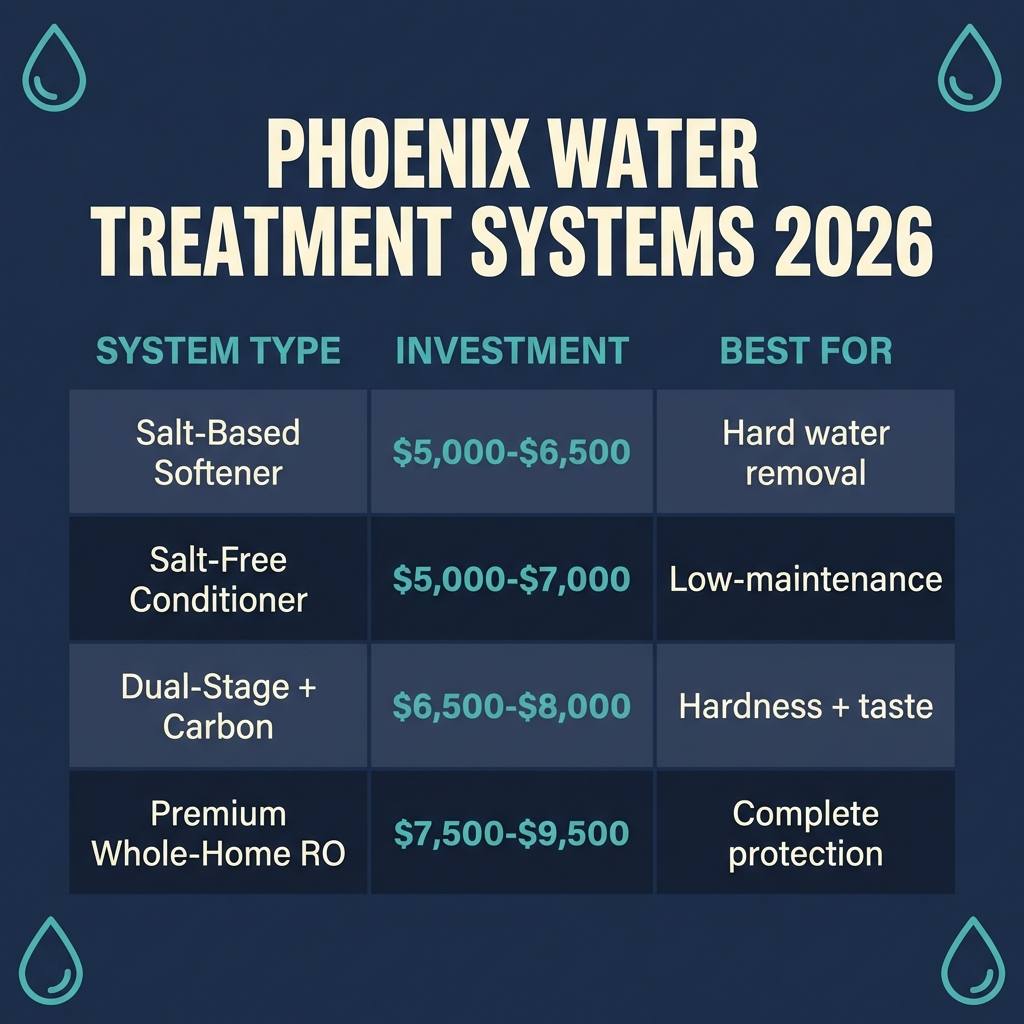
The gold standard for hard water elimination. A salt-based ion exchange softener replaces calcium and magnesium ions with sodium ions, delivering genuinely soft water throughout the home. This is the most effective solution for Phoenix's high-hardness water and the best choice for homes prioritizing appliance protection and skin comfort.
Investment: $5,000-$6,500 professionally installed. Financing available with $0 down and fixed monthly payments.
Instead of removing hardness minerals, conditioners alter their crystalline structure so they can't bond to surfaces. The minerals remain in the water but don't form scale. Salt-free systems are maintenance-light (no salt to refill) and a good option for homeowners who prefer not to add sodium to their water. They're less effective at very high hardness levels (above 300 ppm) but work well in moderate Phoenix-area hardness zones.
Investment: $5,000-$7,000 professionally installed.
For Phoenix homeowners bothered by both hardness and the chloramine taste and odor from the municipal supply, a dual-stage system is the complete solution. A salt-based softener handles the mineral load; a whole-home carbon filter removes chloramines, VOCs, and other taste/odor compounds. The result is water that's soft, clean-tasting, and clear at every tap.
Investment: $6,500-$8,000 professionally installed. Book your free water quality test to find out if a dual-stage system is right for your home.
The comprehensive solution for Phoenix homeowners who want the highest standard of water quality at every tap and for drinking. A whole-home softener or conditioner handles hardness; an under-sink RO system removes dissolved solids, heavy metals, nitrates, and other trace contaminants for drinking and cooking water. This is the right choice for homes with well water, higher TDS readings, or families with specific health concerns.
Investment: $7,500-$9,500 professionally installed.
You've seen the $300 softeners at home improvement stores. Here's the reality: undersized, poorly configured systems don't handle Phoenix's water volume or hardness load. They require constant maintenance, fail within a few years, and often void appliance warranties because the water treatment they provide is inconsistent. A properly sized, professionally installed system is designed for your home's specific flow rate, hardness level, and household demand — and comes with a warranty that actually covers the installation.
Arizona doesn't license water treatment dealers the way some states do, which means the quality bar varies widely. When evaluating a company, look for:
Select Source Water provides free in-home water quality tests across the Phoenix metro area. No sales pressure. No commitment required. Just a clear picture of what's in your water and what — if anything — you should do about it.
Yes — Phoenix Water Services treats the municipal supply to meet all EPA Safe Drinking Water Act standards. But "safe" and "pleasant" aren't the same thing. Hard water that meets safety standards can still damage appliances, irritate skin, and taste noticeably of chloramines. Treatment addresses comfort and protection, not safety compliance.
Phoenix typically ranks among the top 10 hardest-water cities in the US. Denver averages around 70 ppm. Los Angeles averages 100-200 ppm. Phoenix averages 250-350 ppm. The difference is directly tied to Colorado River water and local groundwater geology.
Yes, meaningfully. Soft water heaters operate at full efficiency — studies show professional installation of a softener system can reduce water heating energy use by 20-30%. Soft water also requires less detergent in laundry and dishwashers, reducing those household costs over time.
Yes. Phoenix Water Services adds fluoride at approximately 0.7 mg/L, consistent with federal recommendations for dental health. This is not removed by a standard softener — only a reverse osmosis system removes fluoride.
A properly sized salt-based softener in Phoenix will need salt replenished every 4-8 weeks depending on household size and hardness levels. Annual professional check-ups are recommended to inspect the resin bed, control valve, and brine tank. Select Source Water includes a service plan with all installations.
Yes — but start with a comprehensive water test first. Well water in the Cave Creek, Carefree, and East Valley areas can contain elevated hardness, iron, bacteria, and other contaminants not present in municipal water. The treatment system needs to be sized and sequenced correctly for well water chemistry. Contact us for a free well water test.
Select Source Water specializes in whole-home water treatment for Phoenix metro homeowners. Our process is simple: we test your water, recommend the right system for your home and budget, and install it properly — with no subcontractors and no surprises on the invoice.
Schedule your free in-home water test today and find out exactly what's in your Phoenix water — and what the right solution looks like for your home.

