
Searching for the best water softener in Sacramento? You’re not alone — but the right answer isn’t the same for every home. Sacramento’s water supply is more complex than most homeowners realize, and a system that works great in Elk Grove might be overkill for a home in Midtown Sacramento — or completely insufficient for a well-water property in Sacramento County.
This guide breaks down the best water softener types for Sacramento’s specific water conditions, how to match a system to your neighborhood and household, and what separates a quality installation from a box-store disappointment.
The short answer: For most Sacramento-area homes, a mid-grade demand-initiated salt-based softener is the best fit — typically in the $6,500–$8,000 range with professional installation. Homes dealing with chloramine taste or odor need an added carbon filtration stage. Private well users should start with a full water test before buying anything.
Sacramento’s water isn’t uniformly hard — it varies dramatically depending on which water district or source serves your home:
Beyond hardness, Sacramento’s municipal systems use chloramines (chlorine + ammonia) for disinfection. Unlike regular chlorine, chloramines persist longer in distribution systems and don’t off-gas easily. This means a standard water softener alone won’t fix that chemical taste or smell — you need an added filtration stage.
Here’s how the main system types stack up for Sacramento’s specific water conditions.
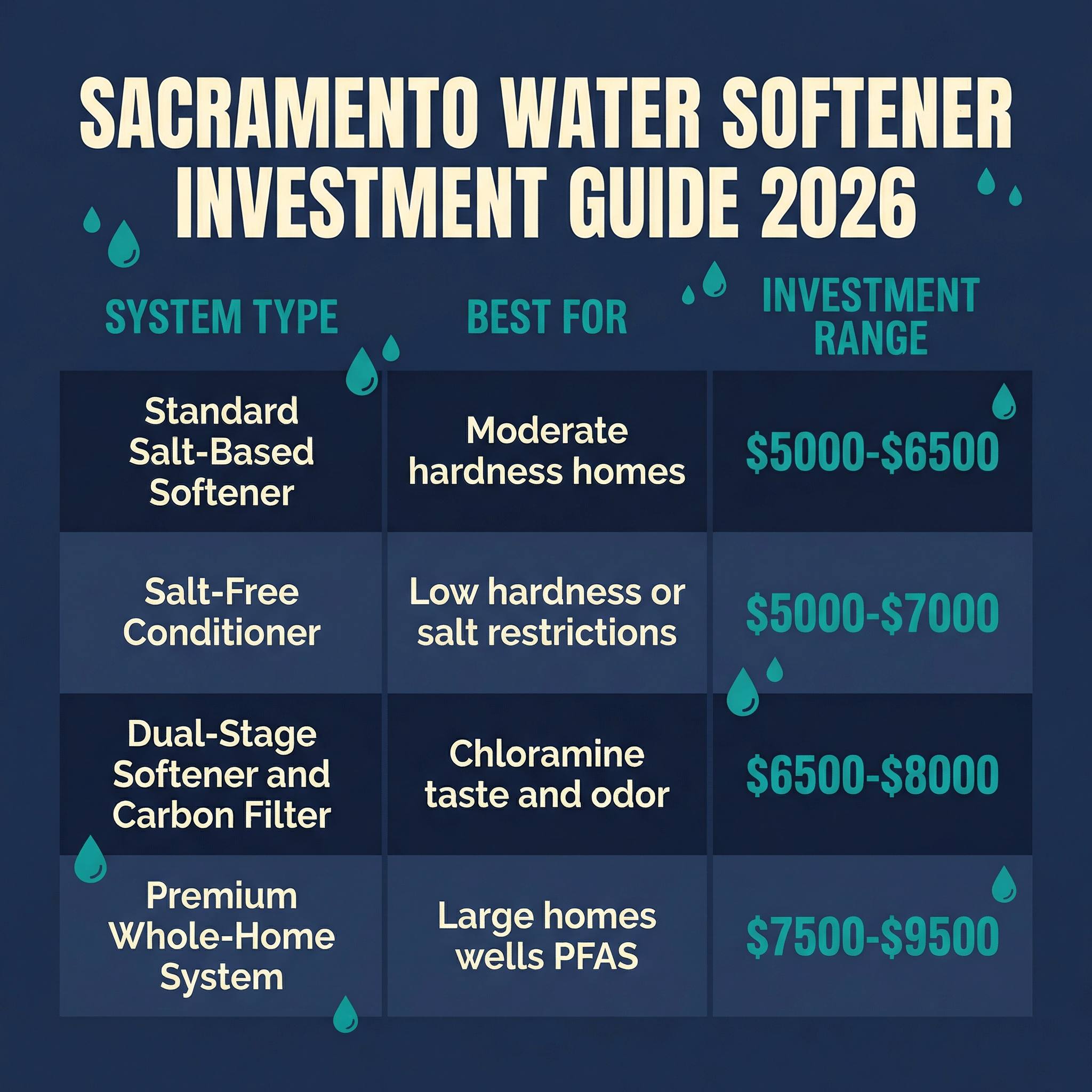
Why it wins: Salt-based ion exchange is the gold standard for removing hardness minerals (calcium and magnesium) from water. For homes in Elk Grove, Folsom, Roseville, and surrounding areas dealing with 8–14 GPG hardness, it’s the clear first choice.
Investment: $5,000–$6,500 professionally installed
Best for: Homes with 2+ bathrooms, city or district water supply, moderate to high hardness
Watch out for: Doesn’t address chloramines, taste, or odor. Some Sacramento-area water districts have salt-discharge restrictions — verify before purchasing.
Why it matters: Salt-free conditioners use template-assisted crystallization (TAC) to transform hardness minerals so they don’t adhere to surfaces. No salt bags, no sodium added to the water, no discharge restrictions.
Investment: $5,000–$7,000 professionally installed
Best for: Homeowners in water districts with salt-discharge ordinances, health-conscious households, or mild hardness (under 7 GPG in city Sacramento)
Watch out for: Less effective at very high hardness levels. Won’t help with chloramine taste or odor.
Why it wins for Sacramento city water: This combination addresses both hardness AND chloramine-related taste and odor in one system. An activated carbon stage upstream of the salt softener traps chloramines, VOCs, and other chemical compounds before they reach your faucets.
Investment: $6,500–$8,000 professionally installed
Best for: City of Sacramento and suburban district customers who notice a chemical smell or flat taste from tap water
Watch out for: Carbon media needs periodic replacement (typically every 3–5 years). Higher upfront cost than softener-only systems.
Why it’s worth considering: Homes on private wells in Sacramento County face arsenic, nitrates, iron, manganese, and PFAS — none of which a standard softener addresses. Whole-home RO systems filter everything at the point of entry.
Investment: $7,500–$9,500 professionally installed
Best for: Private well properties, homes with confirmed PFAS or arsenic contamination, anyone wanting the most comprehensive filtration available
Watch out for: Highest upfront investment. Requires a pre-treatment water test to size correctly.
The fastest way to nail the right system for your specific address is a free in-home water test. Select Source Water offers free in-home water tests throughout Sacramento — click here to book yours.
Buying a water softener without a water test is like buying glasses without an eye exam. A professional in-home test measures:
Armed with this data, a technician can tell you exactly what type of system you need, what size makes sense for your household, and which add-ons are actually worth the cost. No guesswork, no upselling on features you don’t need.
Brand matters less than proper sizing and installation. A correctly sized, professionally installed system will outperform a premium brand that’s poorly sized. Look for NSF/ANSI 44-certified components and demand-initiated regeneration for the best long-term efficiency.
Annual service checks are recommended. The technician will inspect the resin bed, check for salt bridging in the brine tank, verify regeneration settings, and confirm output hardness. Carbon filter stages need media replacement every 3–5 years.
Not on its own. Sacramento uses chloramines, which a salt-based softener doesn’t filter out. You need an activated carbon stage integrated into or added alongside your softener to address taste and odor.
Yes. Select Source Water offers flexible financing with $0 down and fixed monthly payments for qualified homeowners, making it straightforward to invest in the right system without paying everything upfront. Ask about current rates when you book your free water test.
Sacramento County may require a permit for whole-home water treatment installations depending on scope. A licensed contractor handles permit requirements as part of the installation process.
The best water softener for your Sacramento home depends on your water source, hardness level, household size, and whether chloramines or other contaminants are a concern. There’s no universal answer — but there is a fast, free way to find out exactly what you need.
Select Source Water’s certified technicians serve the entire Sacramento metro area. The in-home water test is free, takes about 30 minutes, and gives you a complete, personalized assessment of your water quality — with zero obligation to buy.

